 (+34) 966 425 961
 CONTACTO



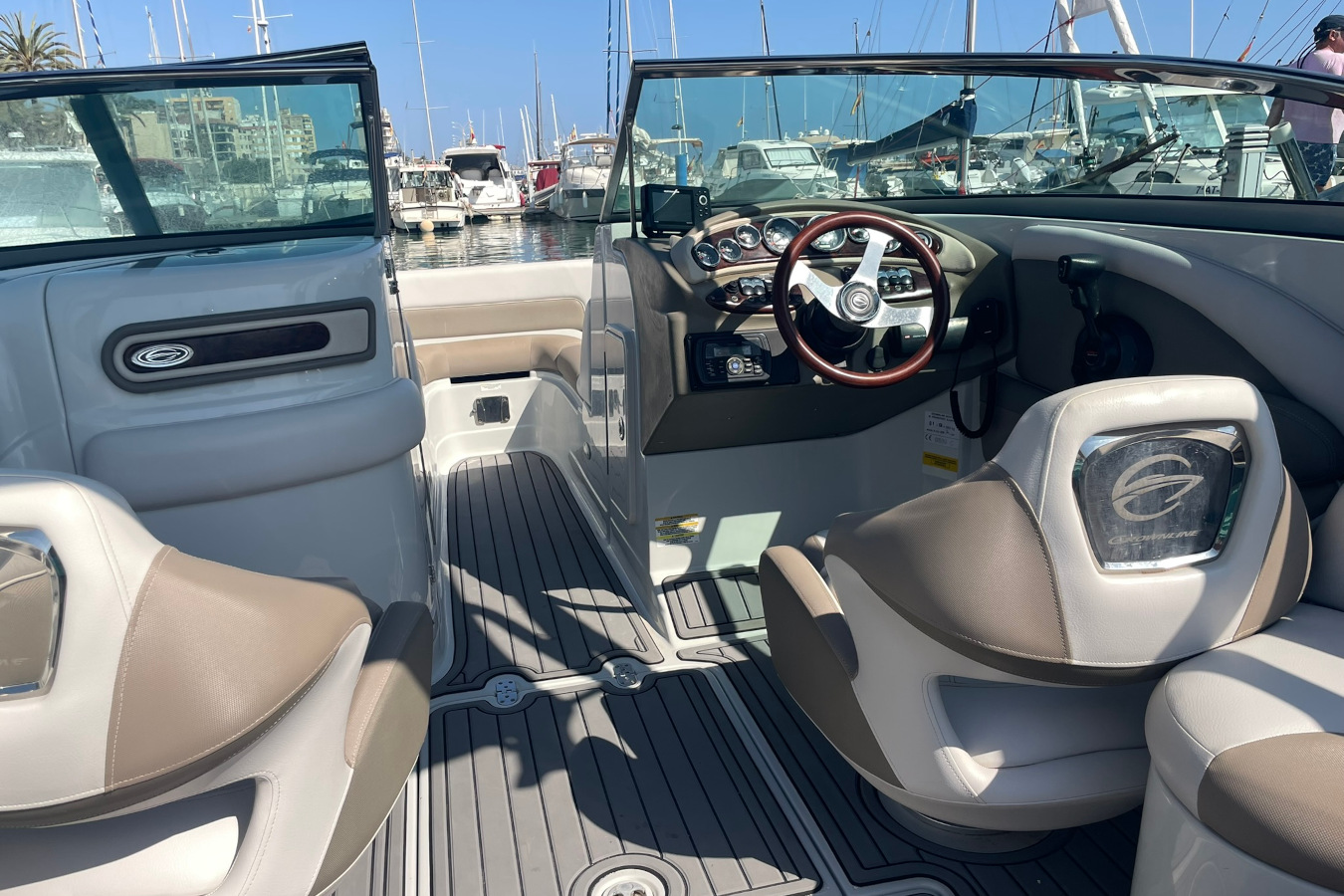
A boat for a couple, a family or guests: how to get the layout right
The right layout depends less on the maximum authorised number of passengers and more on who will use the boat on most outings.
If you mainly go boating as a couple, a manageable boat with two comfortable relaxation areas and enough room to move around is usually a better choice than paying for unnecessary length. For a family, safe movement around the boat, shade, storage and access to the water become more important. If you frequently entertain guests, the priority shifts to a spacious social cockpit, several usable seats while underway and a layout that prevents everyone from gathering at the stern.
The most useful answer can be summarised as follows:
- For couples: easy handling, a good swim platform and two relaxation areas.
- For families: safe movement, shade, storage and visibility.
- For guests: generous social space, seats facing each other and the ability to distribute weight effectively.
The right boat is not the one that can carry the most people according to its technical specifications, but the one that allows your usual number of passengers to cruise, swim and spend time on board comfortably.
Quick comparison: which layout suits each type of user?
| Use profile | Layout that usually works best | Main priorities |
|---|---|---|
| Couple | Compact bowrider or open sport boat | Handling, fuel consumption, swim platform and sunpad |
| Couple with occasional getaways | Cuddy cabin or compact sport cruiser | Protected space, toilet and relaxation |
| Family with children | Bowrider or family deck boat | Safety, shade, storage and movement |
| Family with teenagers | Open layout with a large swimming area | Water sports, space and independence |
| Occasional guests | Spacious social cockpit | Seating, table, access and storage |
| Frequent groups | Larger day boat or crossover | Usable capacity, stability and separate areas |
This table provides an initial guideline. The final decision should also take into account your home port, engine configuration, berth and type of boating.
Authorised capacity and comfortable capacity are not the same thing
One of the most common mistakes when buying a boat is interpreting the maximum number of passengers as a measure of comfort. It is not.
The authorised capacity establishes the maximum number of people the boat can legally carry. Spanish Royal Decree 339/2021 states that the number of people on board cannot exceed the maximum for which the boat is authorised and also requires one life jacket for each occupant.
However, a boat authorised to carry a certain number of people may not be comfortable with all of them on board for an entire day. You also need space for:
- backpacks and personal belongings;
- towels and clothing;
- drinks and food;
- fenders and lines;
- life jackets;
- swimming equipment;
- boards and other water-sports accessories.
When comparing boats, it is therefore important to distinguish between:
Maximum capacity: the technical and legal limit.
Comfortable capacity: the number of people who can sit, move around, eat and swim without the experience becoming cramped.
For a successful purchase, the second figure is often more important than the first, while never exceeding the authorised capacity.
Which layout should you choose if you mainly boat as a couple?
When most outings are for two people, buying a large boat is not always worthwhile. A more compact length can offer easier handling, lower costs and more frequent use.
What a couple really needs
A good layout for two people should provide:
- a comfortable helm;
- a suitable passenger seat;
- a relaxation area at the bow or stern;
- an accessible swim platform;
- sufficient shade;
- enough storage for a full day;
- and freedom to move around without obstacles.
For this profile, a sporty bowrider can make excellent use of the outdoor space. The Crownline 220 SS is 6.65 metres long and 2.59 metres wide, making it a good example of a compact sport boat for recreational boating.
The Crownline 220 SS LPX is another option if you are looking for sportier styling and configuration within a similar length. Its official specifications also list an overall length of 6.65 metres and a beam of 2.59 metres.
When is a small cabin worthwhile?
A cabin can make sense for a couple when you want to:
- have a protected space;
- change clothes in privacy;
- rest during the hottest part of the day;
- store equipment;
- have a toilet;
- or take occasional overnight trips.
However, if you always return to port on the same day and spend most of your time outdoors, a large cabin can take valuable space away from the areas you will actually use most.
The comparison between daycruiser and cuddy cabin: which is best for you explores this decision in greater detail.
Which layout should you choose for family boating?
A family needs more than just enough seats. It needs a layout that makes life on board easier.
When children are on board, the boat should allow adults to keep an eye on what is happening, provide clear walkways and offer enough storage so equipment does not block passages or seating.
Priorities for a family with children
Look for:
- clear walkways;
- accessible grab handles;
- freeboards and backrests that provide a sense of protection;
- good visibility from the helm;
- shade over the social area;
- a stable swim ladder;
- plenty of storage;
- and easy-to-clean surfaces.
It is also important for the helm to remain visually connected to the cockpit. A layout that isolates the skipper makes it harder to supervise children or take part in conversations.
For this type of use, a model with more interior volume and spacious social areas, such as the Crownline E235, can be a good fit.
The Crownline 240 SS is another interesting option for those looking for a combination of performance and comfort in a larger sport boat.
To complete your decision, it is worth reviewing which boat layout is best for family boating on the Costa Blanca.
What changes when your children become teenagers?
Needs evolve. A family with young children usually prioritises supervision, safety and shade. With teenagers, the following become more important:
- the swim platform;
- water sports;
- storage for equipment;
- the sound system;
- the ability to create several separate areas;
- and easy access in and out of the water.
In these cases, an open layout can work particularly well because it allows the bow, cockpit and stern to function as separate areas.
When water sports are a central part of your plans, it makes sense to consider models designed specifically for that purpose. The Crownline E235 Surf is specifically designed for activities such as wakeboarding and wakesurfing.
The Crownline 240 SS Surf is designed as a family-sized water-sports model.
With these models, value is not only about power. The layout must also make it easy to store equipment, keep an eye on participants and help people get back on board safely.
Which layout should you choose if you frequently entertain guests?
When guests are a regular part of how you use the boat, the boat needs to function as a social space. It is not enough simply for everyone to fit on board.
A good layout for groups should allow you to:
- sit facing one another for conversation;
- distribute people between the bow and stern;
- access the fridge or storage without making everyone stand up;
- enter the water without walking through an occupied seating area;
- and store personal belongings without filling the seats.
The cockpit should work like an outdoor living room
A comfortable social cockpit usually has facing seats or a U- or L-shaped configuration. This makes conversation and dining easier than layouts where everyone faces forward and interaction feels less natural.
It is also worth checking whether the table can be installed and removed easily. A large table may be useful during meals but become an obstacle while swimming or underway.
The bow helps spread the group out
On an open boat, a well-designed bow creates a second social area. This prevents all guests from gathering in the cockpit and improves the distribution of space.
The Crownline 240 SS LPX measures 7.26 metres in length and 2.59 metres in beam, providing more social space than more compact alternatives.
For larger groups or buyers looking for a crossover concept, the Crownline 266 SC offers a sport-oriented approach designed for comfortable recreational boating.
Which areas should you analyse before deciding?
1. Helm
Check that the skipper can sit and drive comfortably without becoming separated from the group. Visibility should also remain good when the boat accelerates or carries several passengers.
2. Passenger seat
It should not feel like an uncomfortable secondary seat. When boating as a couple, this seat will be used on virtually every outing.
3. Cockpit
It should allow people to talk, eat and move around without constantly rearranging cushions, tables or bags.
4. Bow
Having seats is not enough. They should provide back support, sufficient depth and reasonably comfortable access so they can genuinely be used throughout the day.
5. Swim platform
This is an essential area in the Mediterranean. It should allow passengers to get in and out of the water safely, handle water-sports equipment and spend time close to the water without taking over the cockpit.
6. Shade
The cover should protect the area where people actually spend their time. A small bimini may look adequate but can prove insufficient after several hours in the summer sun.
7. Storage
Open every storage compartment during your visit. Check its depth, accessibility and real capacity. Useful storage is more valuable than several small, poorly positioned compartments.
8. Toilet or private space
This may be secondary for a couple taking short outings, but it can become much more important for families, groups and full days on board.
Open layout or cabin: how to decide
An open layout is usually more worthwhile when:
- you mainly boat during the day;
- the climate allows you to make the most of outdoor areas;
- you anchor frequently;
- you entertain guests;
- and you do not sleep on board.
A cabin or enclosed space may be worthwhile when:
- you have young children;
- you boat outside the main summer months;
- you want somewhere private to rest;
- you take short trips;
- or you need a toilet and protected storage.
The key is not to sacrifice the area you will use on 90% of your outings for a feature you will only need occasionally.
How much boat length do you really need?
More passengers do not automatically require more length. Beam, cockpit shape, seating layout and the amount of space occupied by the engine or cabin also matter.
As a general guideline:
- a couple can be comfortable in a well-designed compact boat;
- a family usually benefits from more storage and better separation between areas;
- and an owner who frequently entertains guests needs a larger cockpit and several seats that remain usable while underway.
Before moving up in size, also calculate:
- berthing costs;
- fuel consumption;
- maintenance;
- insurance;
- ease of handling;
- and how often you will actually use the boat.
Which layout works best at anchor?
A boat should also be evaluated while stationary. For many families and groups, the number of hours spent at anchor is far greater than the time spent cruising.
During a visit, imagine the following situations:
- several people eating on board;
- two passengers getting into the water;
- someone relaxing at the bow;
- bags and towels stored away;
- children moving between the cockpit and swim platform;
- and the social area protected from the sun.
A boat may look spacious when empty and become uncomfortable as soon as six people and their equipment come aboard.
The guide on how to choose a comfortable boat for spending many hours anchored in a cove explores this situation in more detail.
Common mistakes when choosing a boat layout
Buying for the largest group you can imagine
Choosing a boat based on one annual outing with ten people can leave you paying for additional length, higher running costs and more maintenance throughout the year.
It is usually better to optimise the boat for your normal number of passengers and handle exceptional occasions in another way.
Counting seats without checking whether they are comfortable
Not all seats are equal. Some may be comfortable at anchor but not while underway. Others force passengers to sit sideways or make it difficult to move around.
Prioritising a cabin even though you never use it
A cabin can provide privacy and protection, but it also occupies volume that could otherwise be dedicated to the cockpit or storage.
Forgetting personal equipment
Comfort changes once backpacks, towels, fenders, life jackets, coolers and water-sports equipment are added. Evaluate the boat as it will actually be used.
Not taking a sea trial with passengers
A boat may perform perfectly with just the skipper and a salesperson on board, but its handling and comfort can change with more passengers.
Before deciding, review what you should test during a sea trial before buying a boat.
Decision matrix for choosing the right layout
Give yourself one point for every statement that applies.
Couple profile
- We almost always boat with two people.
- We always return to port on the same day.
- We prioritise easy handling.
- We do not need a large cabin.
- We want to use the boat frequently and without complications.
Four or five points: a compact open sport boat will probably suit you well.
Family profile
- We boat with children or teenagers.
- We need plenty of shade.
- We carry a lot of equipment.
- We spend hours at anchor.
- Safe movement around the boat is particularly important to us.
Four or five points: look for a spacious family-oriented layout with plenty of storage.
Social profile
- We frequently invite other people on board.
- We regularly eat on the boat.
- We need several seating areas.
- We want a cockpit designed for conversation.
- Access to the water is used constantly.
Four or five points: prioritise a day boat or crossover with a large social area and a usable bow.
What to check during a visit
Before choosing a model:
- Have everyone sit in the seats they would use while underway.
- Simulate moving from the cockpit to the swim platform.
- Install the table and check how much walkway remains.
- Open storage compartments without asking people to move from their seats.
- Check the actual coverage provided by the bimini or hardtop.
- Check the skipper’s visibility with passengers on board.
- Imagine where every item will be stored.
- Confirm the authorised capacity and required safety equipment.
- Check the dimensions of your berth.
- Take a sea trial before completing the purchase.
Our recommendation at Crownline Spain
To choose the right layout, base your purchase around the number of people who will usually boat with you:
- Couple: prioritise agility, comfort for two and ease of use.
- Family: prioritise safety, shade, storage and access to the water.
- Guests: look for a spacious social cockpit and several usable areas.
Do not choose solely on the basis of length, appearance or maximum capacity. The boat should work both underway and at anchor, and every passenger should have a comfortable place without obstructing movement around the boat.
You can compare the Crownline boat range, check the boats currently available from Crownline Spain or contact Crownline Spain to determine which layout best suits your usual group, home port and style of boating.
Frequently asked questions
What is the best boat layout for a couple?
For a couple, an open and easy-to-handle boat with a good swim platform, two comfortable areas and sufficient storage usually works well. A cabin may be worthwhile if you want to take short trips or have greater privacy.
What should a boat have for boating with children?
It should offer clear walkways, protective backrests, good visibility from the helm, shade, a stable swim ladder and enough space to store life jackets, towels and toys.
How many people can comfortably fit on a boat?
It depends on the layout, not only on the authorised capacity. You need to distinguish between the legal maximum number of people and the number of occupants who can sit, move around and spend the day on board comfortably.
What boat layout is best for entertaining guests?
A spacious social cockpit, seating arranged to encourage conversation, a usable bow area and access to the water that does not require people to walk through the entire seating area.
Is an open layout or a cabin better?
An open layout usually makes better use of the outdoor space for day trips, time in coves and entertaining guests. A cabin provides protection, privacy, storage and the possibility of resting or staying overnight.
Is it worth buying a longer boat for guests?
Only when guests are a regular part of how you use the boat. Buying a large boat for an occasional trip can unnecessarily increase berthing, fuel and maintenance costs.
Should I test the boat with my family before buying?
Yes. Whenever possible, the sea trial should reproduce your usual use so you can assess visibility, space distribution, movement around the boat, planing and passenger comfort.
Other news you might find interesting
- Boat CE design category A, B, C or D: what does it mean and which one do you need?
- Is a joystick worth installing on a boat? Advantages, limitations and who benefits most
- How to calculate the real range of a boat before setting off
- How to keep your boat in excellent condition all year round
- Single or twin engines: which configuration makes more sense on a recreational boat?