 (+34) 966 425 961
 CONTACTO



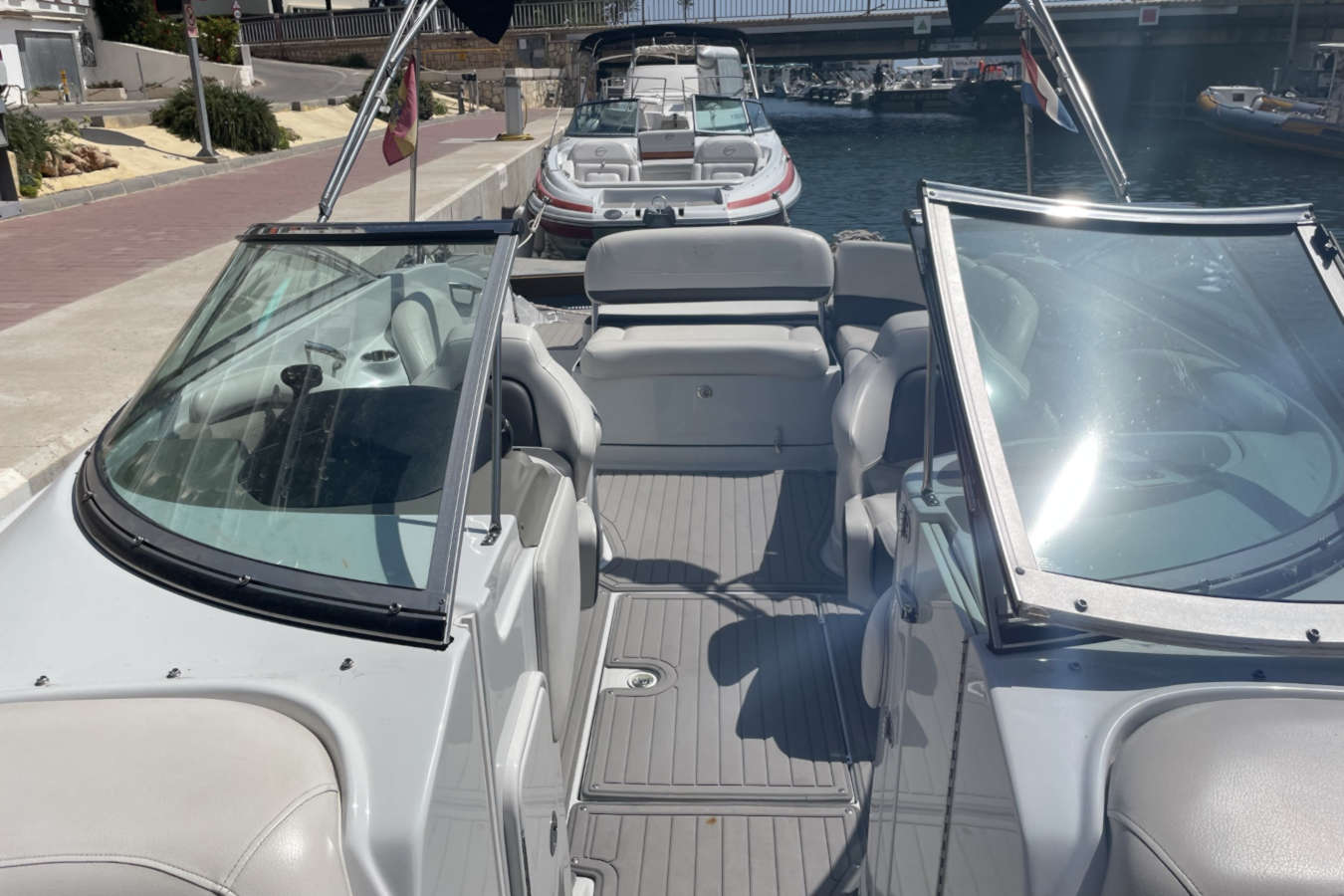
What you should try out on a sea trial before deciding which boat to buy
A sea trial isn’t just a short trip to ‘see if you like the boat’. It’s the moment when you check whether the boat accelerates as you’d expect, planes easily, responds well to your manoeuvres, inspires confidence and suits your actual sailing style. Discover Boating sums it up well: a sea trial should be an essential part of the buying process, because it’s the real test of the boat on the water.
At Crownline Spain, this approach is already evident in various sections of the website: there are references to a sea trial in Dénia within the published content; the second-hand boats section expressly confirms that you can undertake a sea trial before purchasing; and the website features active pages on boats in stock, the Crownline range and news, which fits in very well with a strategy where the sea trial acts as a decisive step before finalising the purchase.
The important question isn’t ‘Did I enjoy going out for a bit?’, but rather: ‘Have I tried it out enough to know whether this boat really suits me?’ That nuance completely changes the focus of the test.
The sea trial should not focus solely on speed
Many buyers jump on board and focus almost exclusively on two things: how it accelerates and how fast it goes. That matters, but it is far from being the only thing that counts. Discover Boating recommends making the most of the sea trial to check the start-up, engine performance, trim, instrumentation, electronics and on-board systems, as well as the boat’s general behaviour on the water.
If you’re comparing models, this test is most useful when you link it to articles we’ve already published, such as ‘How to choose the perfect boat’, ‘How much power do you really need in the Mediterranean?’ or ‘Boats in stock or made to order: which option suits you best in 2026?’. These articles are part of Crownline Spain’s current content ecosystem and tie in directly with the decision you make during a sea trial.
What you really should try during the sea trial
1. Cold start and initial engine response
One of the first things to check is how the boat starts up and what it feels like right from the start. Discover Boating recommends checking that the engine starts easily and runs smoothly, as well as letting it run long enough to warm up so you can observe how it actually performs.
This is particularly important if you’re considering a second-hand boat or one from stock that you want to take home straight away. In that case, it’s also worth checking the ‘second-hand boats’ or ‘boats in stock’ sections, as the approach to the test varies slightly depending on the type of purchase.
2. Glide time and ease of gliding
On a leisure boat, one of the most revealing sensations is the way it planes. It’s not just about whether it can do so, but how it does so under realistic conditions – with several people on board and during normal acceleration – rather than in an ‘empty and perfect’ state. If you’re sailing in the Mediterranean and your boat will actually be used with family or guests, this matters far more than top speed on its own. Crownline Spain has already explored this concept of power and real-world load in its article on power requirements by boat length in the Mediterranean.
3. Visibility from the helm
A sea trial also helps to identify issues that go unnoticed in port. One of these is actual visibility: what you can see when accelerating, turning, manoeuvring slowly and cruising. If the windscreen, the seat, the angle of the hull or the driving position don’t suit you, you’ll notice it straight away on the water, not in a static display. This ties in directly with the idea of choosing a boat based on how you’ll actually use it, which is one of the key themes of Crownline Spain’s content.
4. Smooth manoeuvres and demanding manoeuvres
It’s not enough just to leave the harbour and sail in a straight line. You need to test the boat by making wide turns, smooth course corrections, changes of pace and slow manoeuvres. Discover Boating recommends a test sail long enough to check that the boat and its systems really do work, not just for a few minutes.
In practice, this means you should notice whether the boat feels natural to steer or whether it forces you to make too many corrections, whether it takes corners well or whether it makes you feel less confident than you expected.
5. Realistic wave behaviour
If possible, avoid testing the boat in conditions that are too ‘perfect’. Ideally, you should test the boat in conditions that are typical of your usual sailing area. On the Costa Blanca, this means it’s worth assessing how it handles the short swells typical of the Levante or slightly choppy conditions, not just on flat water. Crownline Spain is already working on content covering Mediterranean use, power and crossings such as the Dénia–Formentera route on a day cruiser.
A very useful external source here is AEMET, as it helps you assess the sea conditions on the day before the test. Checking the official sea forecast allows you to understand whether you are testing the boat in conditions that will actually help you make an informed decision. This point is further emphasised by Crownline Spain in its article on how to read the AEMET forecast before setting sail.
6. Noise, vibrations and overall comfort
There are boats that ‘look the part’ on paper, but fail to impress when you’re out on the water. A sea trial should help you spot excessive noise, unusual vibrations, resonance, uncomfortable seating positions or a general feeling of fatigue, all of which can become a real burden in real-world use. These issues don’t always come up in a catalogue comparison, but they become apparent straight away when you spend time at the helm.
7. Trim, instrumentation and on-board systems
Discover Boating recommends checking during the test that the trim, lights, electronics, instruments and audio system, as well as other on-board systems, are working properly.
That means you shouldn’t go back to the jetty without having tried:
- trim or equivalent adjustment,
- displays and instrumentation,
- basic electronics,
- audio, if that’s relevant to you,
- and any system that affects the actual use of the vessel.
If you’re buying a boat for socialising or family life on board, this ties in very well with articles such as which extras are worth having fitted as standard on a new boat and which aren’t, or which boat layout is best for sailing with the family along the Costa Blanca.
8. How people move about on board whilst you’re sailing
If the purchase isn’t just for you, don’t test the boat as if you were going to use it on your own. Check how others sit, whether there’s plenty of legroom, whether your main companion is comfortable, and whether moving about on board feels natural. Crownline Spain has been focusing on precisely this aspect for some time now in its range of models designed for families, children and practical layout.
What you should ask for before or during the test
For larger boats or more significant purchases, Discover Boating even recommends considering a marine surveyor, particularly where the financial risk is greater. It also emphasises that the sea trial should be a genuine part of the inspection process, not merely a formality.
In practice, it is a good idea to ask for the following before the test:
- that the ship sets sail with a reasonable cargo,
- enough time to try it out at your own pace,
- a basic explanation of systems and equipment,
- and a route that lets you do more than just go out and come back.
Warning signs that should make you think twice
A sea trial isn’t just for confirmation. It’s also for stopping in time.
Things like the following should make you think twice:
- unusual engine behaviour,
- equipment that isn’t quite working properly,
- trim or systems that aren’t working properly,
- strange vibrations,
- or a distinct feeling that the boat isn’t right for you at the helm.
Discover Boating stresses that the test should be long enough to check that the engine and systems are working properly and that, with larger or more expensive boats, it is worth seeking the advice of an expert.
The most common mistake: making a decision based on emotion before finishing the test
The most common mistake is falling in love too soon. You like the boat, the design catches your eye, the weather’s on your side and the trip looks like fun. But a good purchase isn’t decided by a pleasant time on the water, but by a test that answers specific questions.
That’s why it’s a good idea to go into the test with a mini mental checklist:
- Do I feel comfortable running it?
- Is the boat performing as you expected?
- Does the power output seem reasonable for my needs?
- Are visibility, noise and comfort right for me?
- Does the distribution actually work whilst browsing?
If that list isn’t clear, it’s not time to decide just yet.
Our recommendation at Crownline Spain
A good sea trial isn’t the most spectacular one, but the one that provides you with the most useful information. If you’re comparing new, stock or second-hand boats, the smartest thing to do is to make use of the information already available on the website itself: boats in stock, second-hand boats, buying a new boat and the Crownline range. All these sections are active on Crownline Spain and are directly relevant to this stage of the buying process.
And if you’re already at the decision-making stage, it makes sense to get in touch with Crownline Spain and view the sea trial for what it really is: the final, serious step before making a purchase.
Frequently asked questions
How long should a sea trial last?
Long enough for the engine to warm up and for you to check that the systems are working properly; Discover Boating recommends a trip that’s long enough to really verify this.
What should I look for first in a sea trial?
Start-up, engine response, ease of planing, visibility, manoeuvrability, instrumentation and overall comfort. That is the practical summary drawn from Discover Boating’s sea trial checklist.
Is it worth taking a second-hand boat for a test sail?
Yes. Crownline Spain’s used boats section itself states that you can take a test sail before buying.
Is it a good idea to take someone with you?
Yes, especially if that person is also going to use the boat or if they have the experience to help you spot sensations and technical details that you might miss. Discover Boating even suggests taking someone knowledgeable with you or hiring a surveyor for larger boats.
Which external source should you consult before a sea trial?
AEMET, to find out the actual sea conditions under which you are testing the boat, and thus better understand what you experience during the trip.
Other news you might find interesting
- Boat CE design category A, B, C or D: what does it mean and which one do you need?
- Is a joystick worth installing on a boat? Advantages, limitations and who benefits most
- How to calculate the real range of a boat before setting off
- How to keep your boat in excellent condition all year round
- Single or twin engines: which configuration makes more sense on a recreational boat?