 (+34) 966 425 961
 CONTACTO



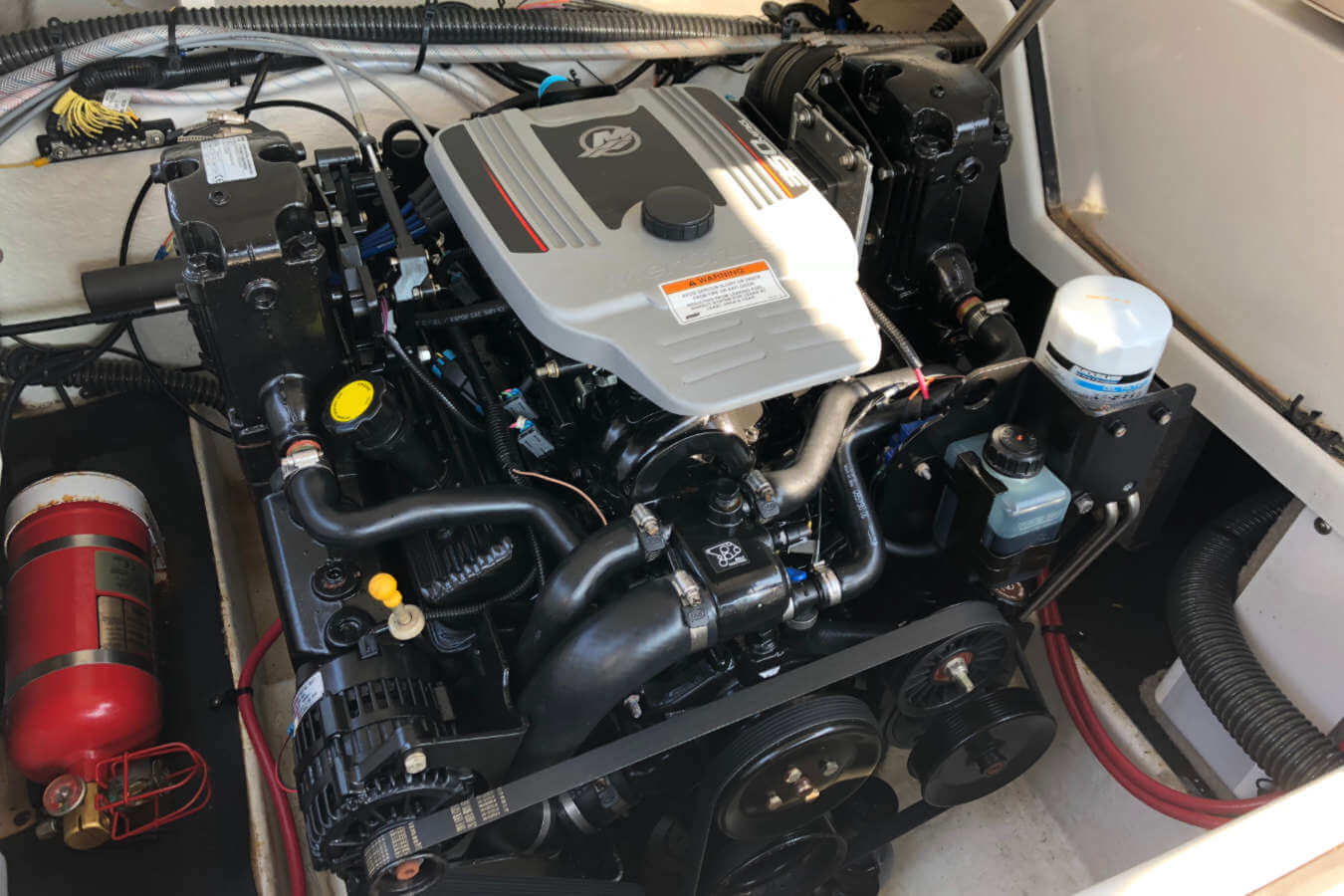
Single or twin engines: which configuration makes more sense on a recreational boat?
Choosing between a single engine and twin engines affects far more than available horsepower.
The decision influences:
purchase price, maintenance, fuel consumption, weight, manoeuvrability, redundancy and the overall behaviour of the boat.
The short answer is:
For recreational boats used mainly for day trips and coastal boating, a correctly sized single engine is often the simpler and more economical solution. Twin engines become more attractive as boat size, weight and required horsepower increase, when longer trips are common, or when redundancy and precise low-speed manoeuvring are particularly important.
Twin engines are not automatically better.
The decision should always be based on:
the specific boat + manufacturer-approved engine configurations + your actual boating habits.
Single engine vs twin engines: quick comparison
| Factor | Single engine | Twin engines |
|---|---|---|
| Purchase price | Usually lower | Usually higher |
| Maintenance | Simpler | More components |
| Weight at the stern | Usually lower | Usually higher |
| Fuel consumption | Can be lower | Depends on configuration |
| Manoeuvrability | Very good with correct technique | Greater independent control |
| Redundancy | No second engine | Second source of propulsion |
| High total horsepower | Limited to one engine | Power can be split between two |
| Complexity | Lower | Higher |
| Joystick systems | System-dependent | More common |
| Coastal day boating | Often very suitable | Not always necessary |
| Long-distance cruising | Can be sufficient | Redundancy becomes more valuable |
The real question is therefore not:
“Which is better?”
It is:
“Which benefits of the second engine will I actually use, and what will those benefits cost me throughout ownership?”
When does a single engine make more sense?
A single engine makes a lot of sense when the boat can achieve its intended performance with one properly sized unit.
This is often the case for:
- day trips;
- coastal boating;
- moderate distances;
- family use;
- relatively low annual engine hours;
- regular return to the same home port.
For an owner who mainly uses the boat for daytime cruising along the Costa Blanca, a correctly matched single engine can offer an excellent balance between performance, purchase cost and maintenance.
Main advantages of a single engine
The first is simplicity.
There is:
- less mechanical equipment;
- fewer components to maintain;
- fewer propellers;
- usually less weight;
- fewer potential mechanical failure points.
For many recreational owners, this simplicity has significant value.
When do twin engines become worthwhile?
Twin engines gain stronger arguments when:
- the boat needs high total horsepower;
- you operate many hours per year;
- you regularly make longer trips;
- you often cruise farther from your home port;
- the boat is heavy;
- you regularly manoeuvre in difficult marinas;
- redundancy is important to you.
In these situations, the additional cost is not simply buying more horsepower.
It may also provide greater operational flexibility.
Before choosing one or two engines, establish how much power the boat actually needs
One of the most common mistakes is starting with:
“One engine or two?”
The previous question should be:
“How much horsepower does this boat actually need?”
The hull needs sufficient power to:
- get onto the plane properly;
- maintain a suitable cruising speed;
- perform with passengers and fuel onboard;
- retain adequate performance margin.
Only then does it make sense to compare configurations such as:
1 × 300 hp versus 2 × 150 hp.
Which is better: 1 × 300 hp or 2 × 150 hp?
Both configurations total 300 hp.
They are not technically equivalent.
Differences include:
- total weight;
- number of propellers;
- propeller area;
- hydrodynamic drag;
- weight distribution;
- manoeuvring control;
- maintenance requirements.
1 × 300 hp
May offer lower weight, less complexity and lower servicing costs.
2 × 150 hp
May provide better low-speed control and some propulsion redundancy if one engine stops operating.
The correct answer depends on the specific boat.
Do twin engines use twice as much fuel?
No.
Two engines do not automatically mean twice the fuel consumption.
When comparing:
1 × 300 hp with 2 × 150 hp
actual fuel burn depends on:
- hull;
- weight;
- engine RPM;
- speed;
- propellers;
- loading;
- trim;
- condition of the hull.
That is why comparing litres per hour alone can be misleading.
A more useful measure is:
litres per nautical mile.
For example:
| Configuration | Fuel burn | Speed | Approx. fuel per mile |
|---|---|---|---|
| A | 25 l/h | 25 kn | 1.00 l/nm |
| B | 30 l/h | 32 kn | 0.94 l/nm |
Configuration B burns more fuel each hour but covers more distance during that hour.
It may therefore be more efficient per nautical mile.
Is a twin-engine boat easier to manoeuvre?
Generally, yes.
This is one of the clearest advantages of twin engines.
Two independently controlled engines can produce different thrust on either side of the boat.
For example:
port engine ahead + starboard engine astern
can help the boat rotate at very low speed.
This can make it easier to manage:
- tight berths;
- reversing manoeuvres;
- crosswinds;
- stern corrections;
- low-speed turns.
A single-engine boat can still be manoeuvred very precisely by a skipper who understands how the boat responds.
Are twin engines safer?
An important distinction is needed.
Twin engines provide propulsion redundancy, but they do not automatically make a boat twice as safe.
If one engine fails, the second may allow the boat to continue moving or return to port.
That can be a genuine advantage.
However, some failures may affect both engines at the same time, including:
- contaminated fuel;
- electrical faults;
- common control systems;
- shared supply systems.
Twin engines therefore do not replace:
maintenance + weather planning + safety equipment + clean fuel + sensible passage planning.
Can you return on one engine if the other fails?
Often, yes.
However, the boat may not retain normal performance.
You may lose:
- speed;
- acceleration;
- ability to plane;
- manoeuvrability;
- efficiency.
Some boats may return comfortably at reduced speed.
Others may no longer be able to get onto the plane using only one engine.
Extra stern weight also matters
Twin engines can add substantial weight at the stern.
This may influence:
- static trim;
- planing behaviour;
- passenger distribution;
- fuel consumption;
- bathing-platform space;
- useful load.
It is therefore not enough simply to add the horsepower figures together.
Is a single engine really cheaper to maintain?
Generally, yes.
| Maintenance item | Single engine | Twin engines |
|---|---|---|
| Engine service | 1 | 2 |
| Oil and filters | 1 system | 2 systems |
| Propellers | 1 | 2 |
| Anodes | 1 set | 2 sets |
| Impellers | 1 | 2 |
| Diagnostics | 1 engine | 2 engines |
| Potential engine repairs | 1 unit | 2 units |
This does not mean total boat ownership costs double.
Mooring, hull care, upholstery, cleaning and many other systems remain common to both configurations.
For a wider view of annual costs, see our guide to the total cost of boat ownership on the Costa Blanca.
How does the number of engines affect range?
Range depends primarily on:
fuel capacity + actual fuel consumption + speed + safety reserve.
The number of engines is only part of the equation.
When comparing configurations, look at:
litres per nautical mile + fuel capacity.
Not just litres per hour.
Which configuration makes more sense for a family?
For family boating, ask:
What practical benefit does my family receive from the second engine?
It may provide:
- easier manoeuvring;
- more power with a full load;
- greater redundancy;
- better performance.
On the other hand, it may also mean:
- higher purchase price;
- more maintenance;
- more weight at the stern.
Before choosing engines, it is often more important to get the right type of boat for family boating on the Costa Blanca right first.
What about watersports?
Twin engines are not automatically better.
For watersports, also consider:
hull + acceleration + torque + propellers + bathing platform + wake + specialised systems.
If wakeboarding, waterskiing or other tow sports are priorities, see what to consider when choosing a watersports boat.
What role does a joystick play?
Some modern multi-engine configurations can be paired with joystick control.
Depending on the system, this may assist with:
- sideways movement;
- rotation;
- stern corrections;
- precise docking.
On a larger boat or at a difficult berth, this can make a significant difference to ease of use.
I would not, however, choose twin engines solely because I wanted joystick control.
Single or twin engines according to boating use
Short coastal day trips
Single engine: often perfectly adequate.
Family boating
One or two engines: depends mainly on size, weight and power requirements.
Frequent long-distance routes
Twin engines: redundancy becomes more valuable.
Larger or heavier boat
Twin engines: may become more logical or necessary.
Difficult marina berth
Twin engines: clear manoeuvring advantages.
Priority on simplicity and cost
Single engine: generally more attractive.
How does engine configuration affect resale?
A future buyer will evaluate:
- number of engines;
- engine hours;
- maintenance;
- horsepower;
- fuel consumption;
- manufacturer;
- service support.
On boats where twin engines are a desirable configuration, they can be very attractive.
But the next owner also knows they will be maintaining two engines.
If future resale is already part of your planning, read how to choose a boat that will be easy to resell in Spain.
And if you are buying used, also learn how to interpret engine hours on a used boat.
Which configuration suits which owner?
| Owner profile | Configuration to investigate first |
|---|---|
| First boat, coastal trips | Single engine |
| Family, day trips | Single engine if power is sufficient |
| Larger boat | Twin engines depending on manufacturer |
| Frequent longer trips | Twin engines |
| Limited maintenance budget | Single engine |
| Difficult berth | Twin engines or manoeuvring aids |
| Intensive use | Assess power and redundancy needs |
| Frequent crossings | Twin engines become more attractive |
The 7 figures to compare before deciding
Always compare:
- Total available horsepower.
- Total installation weight.
- Fuel consumption per nautical mile at cruising speed.
- Acceleration and performance with normal load.
- Annual maintenance cost.
- Low-speed manoeuvring behaviour.
- Performance on one engine if one engine fails in a twin installation.
Common mistake: choosing twin engines only “for safety”
Redundancy is a real advantage.
However, if you only make short trips close to the coast, you may spend years paying for:
higher purchase cost + additional maintenance + extra weight
for a benefit you rarely need.
For regular longer passages, the same investment can make considerably more sense.
Common mistake: choosing a single engine only because it is cheaper
The opposite can also be a mistake.
If the boat is regularly heavily loaded and a single engine is operating close to the lower end of acceptable performance, the initial saving may prove misleading.
A boat that:
- struggles to get onto the plane;
- requires consistently high RPM;
- loses significant performance with passengers;
may simply be underpowered.
Checklist: single or twin engines?
Before deciding, ask:
- Does the manufacturer approve both configurations?
- How much power does the hull actually need?
- What is the difference in installation weight?
- What is the actual fuel burn per nautical mile?
- What is the annual servicing difference?
- Do I mainly make day trips or longer journeys?
- How often do I travel far from port?
- Do I often carry a full load?
- Is my berth difficult?
- How important is redundancy to me?
- Do I need joystick control?
- Have I tried both configurations?
- Can I comfortably afford to maintain two engines?
Conclusion: which is better, a single engine or twins?
A single engine often makes more sense when you prioritise simplicity, lower running costs and mainly undertake coastal or daytime recreational boating.
Twin engines become more compelling when high horsepower, larger boat size, longer routes, redundancy or precise low-speed manoeuvring are important.
The final question is:
What practical benefit will the second engine give me during my real boating trips, and what will that benefit cost me over the long term?
You can compare available configurations across the Crownline model range and review the Crownline boats currently in stock.
For personalised advice on engine configuration, you can contact Crownline Spain.
Frequently asked questions about single and twin engines
Is it better to have one or two engines on a boat?
It depends on the boat and how it will be used. A single engine usually reduces cost and complexity, while twin engines can provide additional power, manoeuvrability and redundancy.
Do twin engines use twice as much fuel?
No. Fuel consumption depends on hull, weight, engines, propellers and speed. Comparing litres per nautical mile is more useful than comparing litres per hour alone.
Is a twin-engine boat safer?
Twin engines provide propulsion redundancy if one engine fails, but they do not replace proper maintenance, passage planning or safety equipment.
Can a twin-engine boat run on one engine?
Often yes, although usually with reduced speed and performance and sometimes without the ability to plane.
Do twin engines make docking easier?
Generally yes, because independent engines allow different thrust to be applied on each side of the boat.
Is a single engine cheaper to maintain?
Generally yes, because only one mechanical unit requires servicing.
At what boat length do you need twin engines?
There is no universal length. It depends on displacement, hull design, required horsepower and manufacturer-approved configurations.
Which is better: 1 × 300 hp or 2 × 150 hp?
The decision cannot be made from total horsepower alone. Weight, fuel consumption, performance, manoeuvrability, maintenance and the specific boat must all be considered.
Are twin engines worth it for coastal boating?
They can be useful, but on many recreational boats used for short day trips, a correctly sized single engine is entirely sufficient.
Do twin engines improve resale value?
They can be attractive on models where twin engines are desirable, although future buyers will also consider the cost of maintaining two engines.
Other news you might find interesting
- Boat CE design category A, B, C or D: what does it mean and which one do you need?
- Is a joystick worth installing on a boat? Advantages, limitations and who benefits most
- How to calculate the real range of a boat before setting off
- How to keep your boat in excellent condition all year round
- Single or twin engines: which configuration makes more sense on a recreational boat?