 (+34) 966 425 961
 CONTACTO



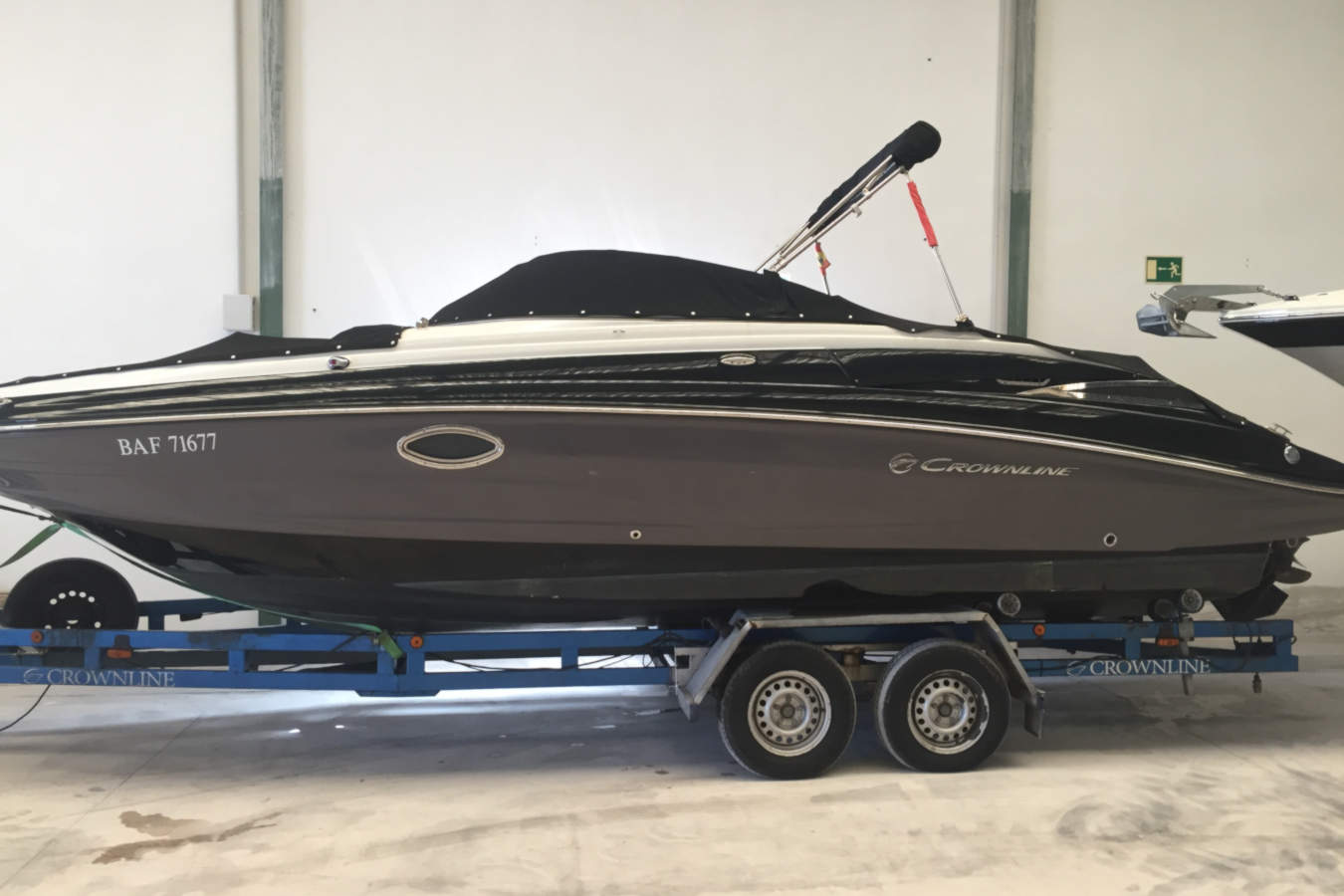
Boat towing and transport: permits, weights and best practices in Spain
Transporting your boat by road can be very convenient (and save you mooring fees or waiting times), but only if you are clear about two things: what permit you need and what weights are allowed. At Crownline Spain, we see it often: the ‘problem’ is not the trailer, but a misunderstood maximum authorised mass (MAM), an ignored maximum permissible weight (MPW) or an unevenly distributed load.
If you are considering a unit that will tow well from day one, you can start by looking at Boats in stock or Used boats; and if you want us to get it ready for you (ball, installation, servicing, tune-up), we can take care of it for you through Services.
Licences to drive a boat with a trailer in Spain: B, B96 and B+E
The rule of thumb is this: permission depends on the gross vehicle weight rating (GVWR) of the combination (car + trailer), not on ‘what you think it weighs today’.
- Category B licence: allows you to tow trailers weighing up to 750 kg GVW; and in some combinations, trailers weighing more than 750 kg if the combination remains within the limits of the licence itself and what the vehicle is authorised for.
- B96: authorisation to extend the combination up to 4,250 kg GVW (car + trailer).
- B+E: allows you to tow a trailer with a maximum authorised mass of up to 3,500 kg with a towing vehicle authorised for category B (and respecting the limits of the combination).
Crownline tip (no surprises): before buying a trailer or choosing a boat, check the technical specifications of the car (MMR with brakes/without brakes and maximum mass of the combination) and the MMA of the trailer. If you like, send us the model of your car + boat and we will help you to fit the combination from Contact.
Weights that really matter: MMA, MMR, and ‘real weight’ (what you carry with you)
If you only take one idea away with you, let it be this: legality can be verified in the documentation (MMA/MMR), safety can be verified in the actual weight and distribution.
- MMA (Maximum Authorised Mass): the legal maximum for each vehicle (car and trailer).
- MMR (Maximum Towable Mass) of the car: how much it can tow, normally separated into braked/unbraked (technical data sheet information).
- Actual transport weight: boat + engine + fuel + batteries + equipment + anchor + refrigerator + awnings + toys +… (this adds up to more than it seems).
Whether buying new or second-hand, it is very useful to plan your ‘trailer package’ from the outset. If you are choosing a unit, you can start by buying a new boat (if you want to customise it) or look for opportunities in second-hand boats.
Trailer registration, insurance and MOT: the key cut-off point is 750 kg
In Spain, the typical threshold is 750 kg of MMA:
- For trailers with a maximum authorised mass (MAM) of over 750 kg, the General Vehicle Regulations stipulate that a number plate must be displayed.
- In the case of ‘light’ trailers (≤ 750 kg GVW), the DGT explains that they do not require separate registration in certain cases (and details the approach for caravans/light trailers).
- Regarding MOT, the casuistry depends on the category and MMA; as a practical guideline, many technical guides distinguish between O1 trailers (≤750) and above, with periodic inspections where applicable.
If you would like us to leave it ‘closed’ (documentation, installation, inspection of lights, rollers, winch, etc.), we can look into it from Services.
Maximum speeds with trailers in Spain (what is often forgotten)
Cars with trailers have specific limits. The official magazine of the DGT (Spanish Traffic Authority) summarises it as follows:
- 90 km/h on motorways/dual carriageways
- 80 km/h on conventional roads
This, in addition to legality, is stability: from a certain point onwards, the sway increases dramatically.
Best practices for transporting a boat (what makes the difference)
Load distribution and ‘ball weight’
Stability starts here. Poor distribution causes swaying, poorer braking and damage to tyres/bearings. As a technical reference, in centre-axle trailers, the relevant regulations limit the vertical load on the coupling to specific maximum percentages.
In practice: do not carry the bow too far back or concentrate the weight at the stern; and avoid travelling with tanks ‘half full’ if this causes liquid displacement.
Securing the boat: fewer ropes, more judgement
- Ratchet straps at stern (both sides) + bow strap/lock to winch.
- The winch strap is not the only safety device: add a redundant bow sling/safety device.
- Protects gelcoat where straps (covers or protectors) rest.
Lights, connection, and 30-second checklist
Before setting off: indicators, brakes, position, fog lights if applicable, secure connector, visible number plate, tyre pressure, spare wheel, jack/wrench, and a check of bearings/temperature at the first stop.
Driving: anticipation and manoeuvring
- Greater safety distance and progressive braking.
- Avoid sudden turns: correct gently.
- On ramps, lock the wheels securely, use wheel chocks if necessary, and do not force the clutch.
If you want more practical guides on navigation, maintenance and ‘real life’ with boats, you will find many resources in News.
Quick checklist to find out if you can tow your boat with your car
- Check the MMR (with brake) on the car’s specifications sheet.
- Check the trailer’s MMA.
- Estimate the actual weight of the loaded vessel (including equipment).
- Confirm which licence you require: B / B96 / B+E.
- Check whether your trailer requires its own registration (>750 MMA).
If you tell us the model of your car, boat and trailer (or the type of boat you are considering), we will get back to you in 1–2 messages via Contact.
Frequently asked questions
Can I tow a boat with a B licence?
Yes, in many cases. For example, with trailers up to 750 kg GVW and other combinations within the limits of the licence and the vehicle.
When do I need B96?
When do I need B96? When the trailer exceeds 750 kg of maximum authorised mass and the combination (car + trailer) falls within the range permitted by the B96 authorisation (up to 4,250 kg).
When do I need the B+E?
When you need to tow a larger trailer: the B+E licence allows combinations with trailers weighing up to 3,500 kg GVW (subject to the limits of the towing vehicle).
How fast can I go with a trailer?
As a general rule: 90 km/h on motorways/dual carriageways and 80 km/h on conventional roads for cars with trailers.
Does my trailer need its own registration number?
If the trailer’s maximum authorised mass (MAM) exceeds 750 kg, the General Vehicle Regulations require a number plate.
Other news that may interest you
- How to keep your boat in excellent condition all year round
- Single or twin engines: which configuration makes more sense on a recreational boat?
- How many engine hours are a lot on a used boat? How to interpret actual use
- How to choose a boat that will be easy to resell in Spain in a few years
- When is it worth buying a boat before the summer, and when is it better to wait until the end of the season?