 (+34) 966 425 961
 CONTACTO



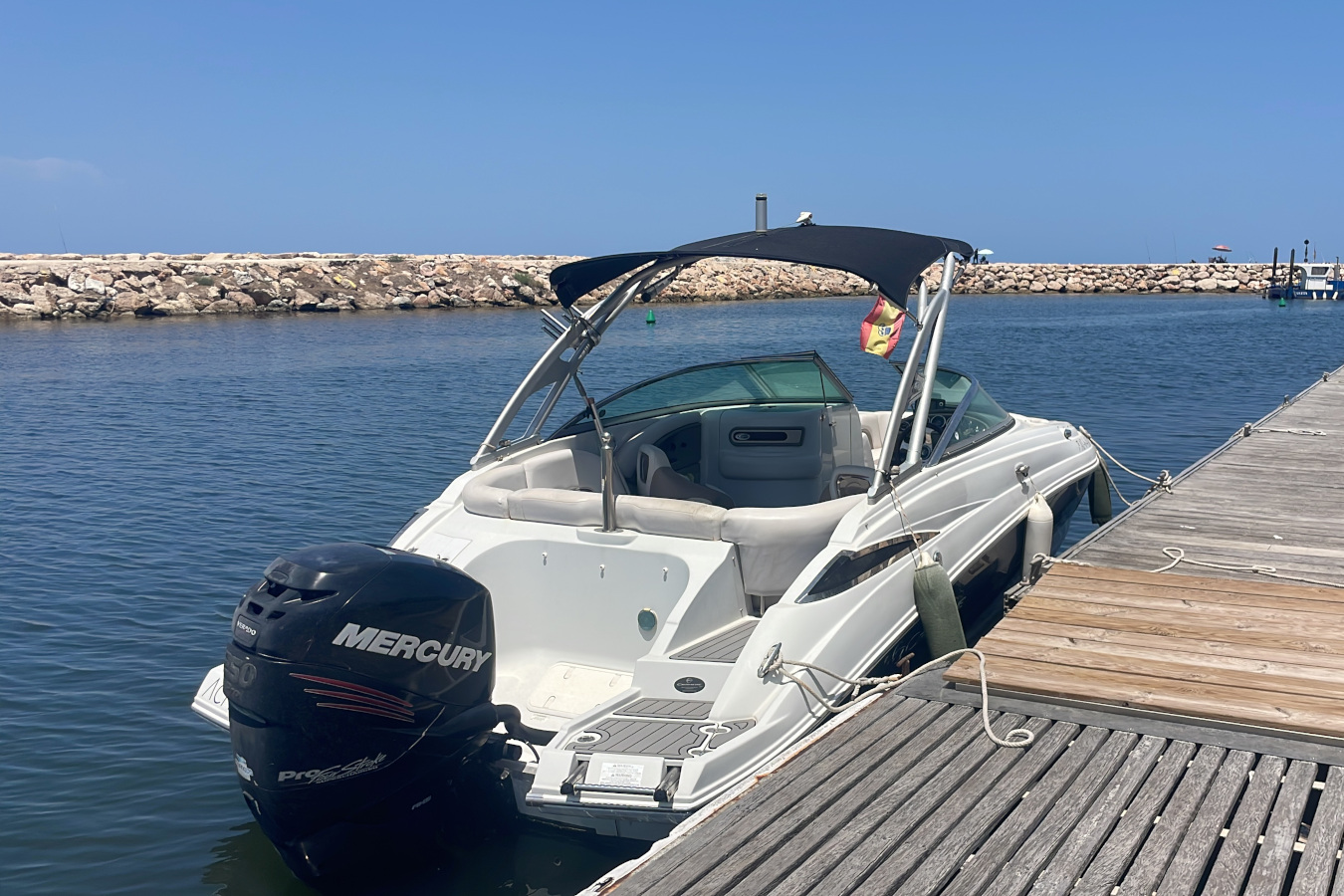
Crownline vs. other sports brands: design, hull, and open sea performance
When you compare Crownline with other sports brands, the real differences emerge in the hull, weight distribution, and tuning. If you are considering a dayboat for the Mediterranean (short waves, thermal waves, and swell), it is worth looking beyond the sales brochure. Before getting into the details, you can review Crownline’s product philosophy in its Outboard range and specific examples such as the 280 SS (single inboard/inline engine) or the 290 XSS (outboard) to get a reference point for design and finishes.
What you see (and what you don’t) in design
Bathtub design and ergonomics. In sport dayboats, Crownline prioritizes wide walkways, seats with reversible backrests, and deep storage compartments. This can be seen in models such as the 280 SS and 290 XSS: clear access to the bow and generous swim platforms. In comparable brands, the layout may seem similar, but the modularity of the furniture (tables, backrests, wet bar) and the angles of back support make a difference in comfort at cruising speed.
Finishes and details. Integrated T-Tops, contrasting stitching, uniform gelcoat, and oversized hardware. At Crownline, small decisions (oversized hinges, hidden fasteners, spot lighting) ultimately give a feeling of solidity; outside the port, they translate into less noise and vibration.
Helmet: Deep V, angles, and control
Deadrise and underwater hull. Crownline’s typical deep V helps cut through short waves with less pantographing. In open sea (20–27 knots), this V keeps the trim within a comfortable range, reducing spray at the bow. Other brands may opt for a less pronounced V to favor immediate acceleration or initial stability when stationary, but in Mediterranean wind waves, the pronounced V ensures greater comfort when cruising.
Weight distribution. Crownline tends to center masses (tanks, stowage) avoiding extreme ballast in the bow/stern; this improves the pitch/takeoff when planing and reduces the tendency to pitch with short waves. In some alternatives, the combination of heavy furniture in the bow and tanks in the stern may require more trim tab work to maintain attitude.
Eclipse and Surf: attitude control. In the Eclipse family (and in Surf models such as the 260 SS Surf), the hull and tabs work with greater authority at medium speed, which is very useful when the thermals lift that half-meter wave.
Performance in open sea (Mediterranean)
Realistic cruising. With a family load (5–8 passengers), a well-trimmed 280 SS sails at 24–27 knots with poise. The 290 XSS, with moderate twin outboards, offers authority at the throttle to jump between wave trains. In brands with a shallower V, top speed may be high when planing, but comfort is reduced when the sea becomes choppy.
Acceleration and fuel consumption. The engine/propeller combination is key. Crownline usually provides configurations that have been tested for length and use, making it easy to find the sweet spot without trial and error. Other brands offer similar ranges, but it is advisable to test them with your actual load.
Government and manoeuvrability. From 8 m onwards, twin outboard engines (XSS) or inboard packages with duo-prop stern drives in SS facilitate manoeuvring in port and stabilise the boat at low speeds. Here, the adjustment of the engine height and propeller pitch makes more of a difference than the brand itself.
Quick comparison
| Appearance | Crownline | Other sports brands |
|---|---|---|
| Bathtub design | Modular, wide aisles and spacious platforms | Similar in layout, less modularity in some models |
| Hull (deadrise) | Deep V for comfort in short waves | Moderate V for faster acceleration on flat water |
| Stowage and weights | Centred/balanced | Occasional bow/stern bias |
| Typical performance | 24–27 kn comfortable with 5–8 passengers | High speed on flat water, variable comfort in choppy seas |
| Tuning | Engine/propeller packs tested by length | Requires more iteration in some cases |
Approximate values with light sea swell and family load.
What to look for in a sea trial
- Useful trim at 22–26 knots: the boat maintains attitude without tabs at the limit.
- Pantocazo and spray: dry bow and stable trajectory in wind waves.
- Noise and vibrations: fittings, furniture and box lids.
- Propeller sweet spot: rpm within the recommended range for your actual load.
- Government in port: response to gas strokes and corrections with the rudder.
Real examples for comparison
- Single-engine sports boat (SS): 280 SS – benchmark in cockpit comfort and stability in short waves.
- Twin-engine outboard (XSS): 290 XSS – wide cruising range, fine manoeuvrability and large platform.
- Family surfing: 260 SS Surf – attitude control and versatility in tow sports.
If you want an overview by family: SS Series for classic sportiness, Eclipse for social boats, and Outboard for efficiency and ease of maintenance.
Frequently asked questions
Does a deep V consume more fuel?
With the same weight and propeller, it may require slightly more power to maintain cruising speed, but this is offset by greater comfort in choppy seas.
Twin engine or single engine for 8 m?
Twin engines give power and manoeuvrability in port; single engines reduce cost/servicing. It depends on the usual use and load.
What is the difference between SS and XSS?
SS groups together models with inboard/inline engines and classic cockpits; XSS focuses on outboard engines and optimised platforms.
Can I compare it with other brands in Dénia?
We can schedule a sea trial with real load and adjusted propeller configuration. Write to us via the contact form.
Other news that may interest you
- How to keep your boat in excellent condition all year round
- Single or twin engines: which configuration makes more sense on a recreational boat?
- How many engine hours are a lot on a used boat? How to interpret actual use
- How to choose a boat that will be easy to resell in Spain in a few years
- When is it worth buying a boat before the summer, and when is it better to wait until the end of the season?