 (+34) 966 425 961
 CONTACTO



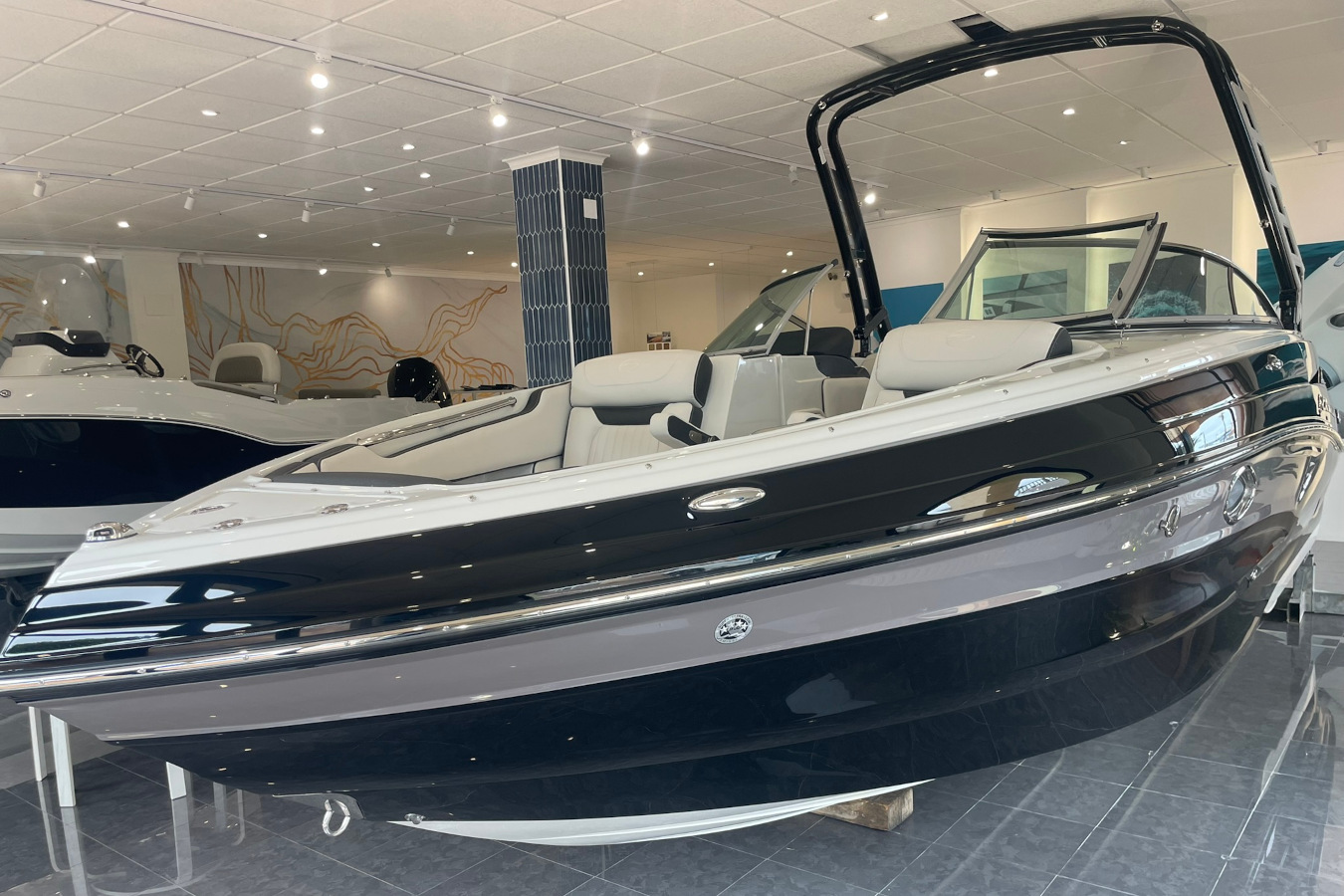
SS vs XSS series in real-world use in coves: access to the sea, gliding and consumption with typical Levante swell
Choosing between Crownline SS (mostly with sterndrive engines) and Crownline XSS (outboard platform) goes far beyond reading a technical specification sheet. If your plan is to visit coves and go swimming in Dénia, Jávea or Moraira, with short Levante waves and thermal afternoons, what really matters is how you get in and out of the water, how the boat planes with a loaded cockpit and how much fuel you consume during the day.
To get a quick overview of each family, you can browse the official categories: SS Series and Outboard (XSS). If you then want to see specific units ready for delivery or fully serviced, explore boats in stock and used boats. Our team can configure electronics, shades and turnkey delivery from Services and coordinate your home mooring.
How we did the comparison (what you’ll really notice)
- Actual scenario: 4–8 people, refrigerator, inflatable toys, and snorkelling equipment.
- Typical weather: E/SE thermal in the afternoon, short-period sea; requires playing with trim and flaps/tabs.
- Length range: 6.5–9 m (sweet spot family day cruiser).
- Decision metrics:
- Flow of access to the toilet and return on board.
- Gliding time with load.
- Average daily consumption (not just specific l/h).
- Manoeuvring in the dock with crosswinds.
Access to the bathroom and life on board in Cala
SS: “flat and social” platform
- Spacious, uncluttered platform: sitting down, helping children and organising mats is extremely comfortable.
- Natural passage from the bathing platform to the stern: with no engine taking up space, the area is used as a ‘saloon at sea level’.
- Caution in calm seas: keep an eye on the fenders and climb aboard if a wave comes in from astern; it is advisable to adjust the ropes so that it does not hit.
XSS: direct staircase and side corridor
- Highly accessible bathing ladder and side step that avoids detours: perfect for constant ‘up and down’ snorkelling.
- Keep cables and toys tidy: with an outboard motor, organise everything well so that nothing rubs against the motor tail.
Practical conclusion: if your plan is to chill on the platform and chat at the stern, SS has a slight advantage. If you will be getting in and out of the water a lot, XSS will be more agile.
Gliding with load and control in short sea conditions
SS
- The sterndrive pair delivers smooth progression that pampers the crew when you’re carrying a full fridge and 6–8 passengers.
- With tabs and fine trim, the angle of attack remains stable in short seas.
- The interior engine shifts the weight towards the centre, helping with longitudinal balance when carrying passengers.
XSS
- The outboard responds instantly: ideal if you alternate between stopping and starting to change coves or pull an inflatable.
- With a heavy load at the bow, compensate with negative trim when departing so as not to lift too much.
- In repeated manoeuvres (game day), that immediacy is noticeable.
Technical tie: families who value progressiveness and ‘everything at a steady pace’ feel very comfortable in SS; active profiles who string together coves will appreciate the reaction of XSS.
Consumption and range on a ‘day of coves’
- Long and steady downwind runs (18–24 knots): a well-trimmed SS can achieve moderate fuel consumption thanks to its hull and stable running speed.
- Modular navigation in stages (10–25 min between stops): the XSS usually matches or improves on the daily average thanks to the efficiency of the outboard motor in partial loads and its speed in entering/exiting the operating range.
Useful external tip: before setting sail, check real-time wave and wind conditions to adjust your route and fuel consumption on the State Ports Buoy Network.
Manoeuvring in port and anchoring
- SS: conveys predictable inertia and ‘solid’ turning; very pleasant on streets with some return wave.
- XSS: the directionality of the outboard motor allows for fine corrections in crosswinds.
- Bow thruster: recommended for long vessels in both cases if your dock is demanding.
Anchoring in calm seas: use a properly sized anchor, plenty of chain, and cushioning on the stern lines if you are going to swim nearby. In SS, pay attention to the height of the platform; in XSS, check the angle of the propeller when turning so as not to touch the lines.
Acoustic comfort and conversation
- SS: uniform tone and content in cruise mode; premium environment for soft music and conversation.
- XSS: very quiet idling; at high speeds, the outboard motor’s sound is more noticeable at the stern.
- In both cases, adjusting RPM and trim to the sea conditions of the day is the key to conversing without raising your voice.
What type of person are you? Quick recommendation
- ‘Platform & chill’ family (children, grandparents): SS for its clear platform and long cruises.
- Assets: ‘up-down & fin changes’ (friends, continuous snorkelling): XSS for smooth climbing and immediate response.
- Mixed with some island hopping: SS if you prioritise range and stability; XSS if you prefer easy maintenance and a brisk pace for anchorages.
- Light fishing + family: XSS for sideways movement and fine control on ramps, without compromising comfort.
If you already see yourself in one or the other, compare actual models in the SS Series and Outboard/XSS, and check availability in stock or second-hand.
Checklist for your A/B test
- Same weather and load (people and equipment).
- Time 0 → 18–22 knots (start of planing).
- Note RPM and comfortable cruising knots (and tab/trim position).
- Assess bathing flow: how many movements and supports are needed to get in and out of the bath.
- Manoeuvring in the dock with crosswinds (simulates August).
- Estimate total consumption for the day (not just l/h at one point).
Would you like us to prepare a double demo (SS and XSS) and configure shadows, electronics, and aesthetic details? We will coordinate everything and deliver it ready to go to your mooring from Services. To arrange a date, please write to us at Contact.
Frequently asked questions (FAQ)
1) Which offers better access to the bathing area for families with children?
The SS stands out for its wide, uncluttered bathing platform, which is very comfortable for sitting and helping children. The XSS wins out when it comes to repeated ascents and descents thanks to its direct ladder and side passage next to the outboard motor.
2) Which series gets up on plane first with 6–8 people and a fridge on board?
Practical tie: the SS delivers progressive, stable torque, while the XSS responds instantly; if you make a lot of stops and starts, you’ll notice the outboard’s immediacy.
3) On a ‘day of coves’, which consumes less on average?
On long, steady runs, the well-trimmed SS tends to perform better. When sailing between coves, the XSS usually matches or improves on the average thanks to its efficiency in partial runs.
4) Which option is quieter when cruising?
The SS offers a uniform and subdued sound in the cockpit. The XSS is very quiet when idling; at high speeds, the sound of the outboard motor is more noticeable at the stern.
5) Which handles best in crosswinds in the harbour?
The SS transmits predictable inertia and ‘solid’ turns. The XSS allows for fine corrections with the outboard’s turn. In longer lengths, a bow thruster helps in both.
6) Are there any significant maintenance differences?
The SS requires attention to the stern (tails); the XSS simplifies outboard maintenance. With a proactive annual plan, both TCOs remain under control.
7) For snorkelling and water games, which is more practical?
The XSS is very agile for continuous ‘up and down’ movement. The SS is unbeatable for relaxing on the deck and organising inflatables in calm conditions.
8) How does weight distribution affect the Levante’s short sea?
In SS, the inboard engine contributes to balance and smooths out pitching. In XSS, use negative trim when departing and adjust tabs to keep the bow down between gusts.
9) Does the range vary significantly between SS and XSS?
It depends on the battery, power and operating conditions. At a steady cruising speed, SS can be very efficient; when used intermittently, XSS maintains competitive ranges.
10) What should I measure in an A/B test before making a decision?
Similar weather conditions, same load, gliding time, comfortable cruising RPM/knots, ease of access to the toilet, crosswind manoeuvrability and estimated total consumption for the day.
11) Which retains its resale value better?
Both well-maintained families rotate well. In areas with high demand for outboards, the XSS may move somewhat faster; a premium, well-cared-for SS also retains its value.
12) Which profiles are best suited to each series?
‘Platform & chill’ family → SS.
Active ‘up-and-down & change of pace’ → XSS.
Mixed with some island hopping → SS if you prioritise range/stability; XSS if you value simple maintenance and agile pace.
Would you like to compare an SS and an XSS of equivalent length this week? Discover options in boats in stock and used boats, configure your delivery in Services and contact us here: Contact.
Other news that may interest you
- How to keep your boat in excellent condition all year round
- Single or twin engines: which configuration makes more sense on a recreational boat?
- How many engine hours are a lot on a used boat? How to interpret actual use
- How to choose a boat that will be easy to resell in Spain in a few years
- When is it worth buying a boat before the summer, and when is it better to wait until the end of the season?